In partnership with


The first phase was adoption. New tools, new systems, new pilots, new language. That work mattered, but it was never the final test. The real test is whether finance can turn that activity into stronger controls, clearer decisions, and measurable operating value.
That is the signal this week. Agentic AI is starting to move from advisory support into execution. ERP systems are being judged less by implementation milestones and more by payback. Finance teams are being asked to move beyond stewardship and become stronger data strategists for the business.
This issue covers AI control design, ERP value extraction, and a practical framework for turning finance technology into governed operating leverage.
The signal is not automation by itself. It is whether the system creates measurable operating value once governance, repeatability, and scale are put around it. That is the standard finance should be applying across AI, ERP, and every other technology investment now moving from experimentation into execution.
That is why Miso Robotics is worth a look. It is a concrete example of automation built around operational consistency, which makes it easier to evaluate through the lens finance should care about most.
“AI is Going to Fundamentally Change…Everything”

That’s what NVIDIA CEO Jensen Huang just said about the AI boom, even calling it “the largest infrastructure buildout in human history.”
NVIDIA’s chips made this real-time revolution possible, but now it’s collaborating with Miso to unlock amazing new advances in robotics.
Already a first-mover in the $1T fast-food industry, Miso’s AI-powered Flippy Fry Station robots have worked 200K+ hours for leading brands like White Castle, just surpassing 5M+ baskets of fried food.
And this latest NVIDIA collaboration unlocks up to 35% faster performance for Miso’s robots, which can cook perfect fried foods 24/7. In an industry experiencing 144% labor turnover, where speed is key, those gains can be game-changing.
There are 100K+ US fast-food locations in desperate need, a $4B/year revenue opportunity for Miso. And you can invest alongside Ecolab and become a Miso shareholder today. Even better, you can unlock free additional bonus stock for a limited time. Become a Miso investor today.
This is a paid advertisement for Miso Robotics’ Regulation A offering. Please read the offering circular at invest.misorobotics.com.
THE NUMBER
52%
The average ROI for an ERP project now sits around 52%, according to reporting from The CFO. That sounds strong. It also hides the harder problem.
Most organizations do not see those gains hit the ledger for two to three years. That delay creates a dangerous middle ground for finance leaders. The project can appear complete even when the value is still unproven.
That is where CFO discipline matters. A system going live is not the same thing as a system paying back.
THE CFO EDGE: The Control-to-Value Map

A finance team can approve an AI pilot, fund an ERP upgrade, or add new automation without improving the business. That is not because the technology is useless. It is because the operating model around it is weak. The better finance teams are starting from a different place. They are asking what the system is allowed to do, who owns the outcome, what financial result it should change, and when the proof will be visible.
Step 1: Define the operating boundary
For agentic AI, the key question is not just what the tool can do. It is what the tool is allowed to do. Can it access vendor data? Can it draft journal entries? Can it initiate a workflow? Can it recommend a payment? Can it execute anything without approval? The more autonomous the system becomes, the more finance has to treat the control layer as part of the operating model.
Step 2: Assign a financial outcome
Every major finance technology initiative should point to a measurable result.
Close time. Forecast accuracy. Working capital. Cost to serve. Labor productivity. Error reduction. Margin visibility. If the initiative cannot be connected to a financial outcome, it is probably still too broad.
Step 3: Separate launch from value
A live system is only a milestone. It is not proof. ERP projects are especially vulnerable here. The implementation can be technically successful while teams continue to work around the system via spreadsheets, manual fixes, or old approval habits. Finance should track system completion and financial evidence as two different things.
Step 4: Build the audit trail early
Agentic AI makes this even more important. If a system can act, not just analyze, finance needs a record of what it accessed, what it changed, what it recommended, what it executed, and when a human was required to approve the action. Governance cannot be added after the fact. It has to be designed into the workflow before scale.Step 5: Reinvest capacity with intent
Automation only creates value if the freed capacity gets redeployed into better work. That means scenario planning, margin analysis, business partnering, pricing support, risk review, and decision support. If finance saves time but does not redirect it, the value leaks.
Immediate payoff:
Finance gets a cleaner way to evaluate technology spend. The conversation moves from “we launched it” to “here is what changed, here is who owns it, and here is the financial evidence.”
THE EXECUTIVE BRIEF

CFOs are increasingly focusing on agentic AI tools as AI systems shift from merely informing decisions to actively executing tasks such as reconciliations, reporting, workflows, and transactions.
My take: This is the right control conversation. Once AI begins operating within financial systems, the CFO has to be concerned with access, permissions, audit trails, escalation paths, and human oversight. The goal is not to slow AI down. It is to make sure the organization can trust what AI is allowed to do.

ERP value has shifted from simple integration to demonstrating measurable benefits. Finance leaders now focus on how the system improves visibility, enhances productivity, controls purchasing, supports forecasting, and facilitates process redesign.
My take: This is where many ERP projects lose credibility. The business celebrates the go-live, but the controller still cannot point to a verified financial impact. CFOs should make payback a governance issue, not a post-implementation talking point.
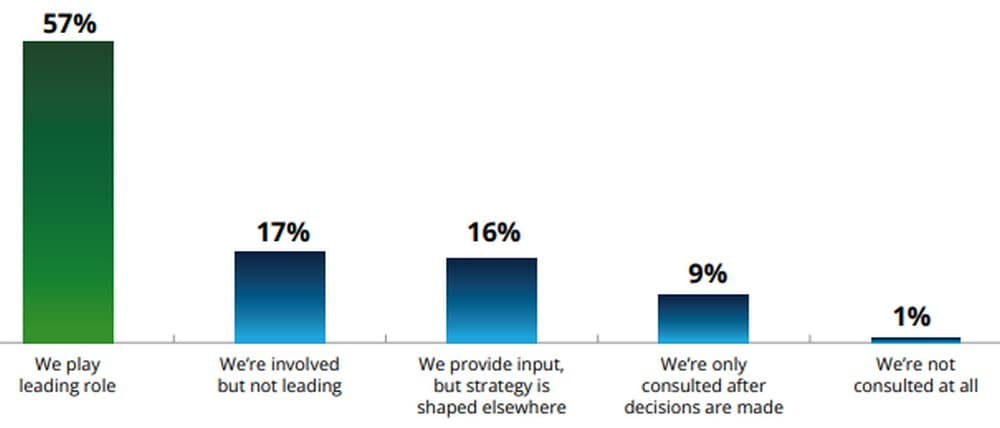
Finance leaders are shifting from traditional stewardship toward a more strategic data role, with CFOs increasingly expected to shape enterprise transformation through real-time data, AI, forecasting, and scenario planning.
My take: This is the broader mandate behind the AI-and-ERP conversation. Finance is not just protecting value anymore. It is being asked to create value by owning the data story, the KPI architecture, and the connection between technology investment and business outcomes.
FINANCE STACK: The Evidence Register

The finance stack is getting more powerful. That does not automatically make it more valuable. The missing layer is often evidence. A CFO can have AI pilots in motion, ERP upgrades underway, dashboards live, automation running, and still lack a clear view of what is changing financially. That creates a problem in the next budget cycle. The team has activity, but not enough proof.
Build an evidence register.
For every major finance technology initiative, track five things:
Owner
Name the person accountable for the workflow, not just the system.Financial outcome
Tie the work to one measurable result. Close speed, forecast accuracy, cost reduction, working capital, margin visibility, or labor productivity.
Control requirement
Document what permissions, approvals, audit trails, and exception rules are required before the workflow scales.
Evidence stage
Mark the initiative as early signal, measurable impact, scale-ready, or under review.
Next funding decision
Connect evidence to capital. If the initiative needs more funding, the proof threshold should be clear before the ask arrives.
Control check:
Can your team show which technology investments are producing measurable value, which are still being tested, and which are consuming budget without enough evidence? If not, the finance stack is probably harder to govern than it needs to be.
That is the standard now. The question is not whether a new tool can create activity. It is whether the operating model around it makes performance measurable, repeatable, and worth scaling. Finance has to apply that filter well beyond internal systems.
That is why this Roku case study is worth a look. It shows how LolaVie used CTV to reach new customers with a strategy built around clearer measurement and more practical execution.
How Jennifer Aniston’s LolaVie brand grew sales 40% with CTV ads

The DTC beauty category is crowded. To break through, Jennifer Aniston’s brand LolaVie, worked with Roku Ads Manager to easily set up, test, and optimize CTV ad creatives. The campaign helped drive a big lift in sales and customer growth, helping LolaVie break through in the crowded beauty category.
CFO PULSE
Where does your finance team need the clearest proof right now?
THE BOTTOM LINE
The CFO role is not getting smaller.
Agentic AI is pushing finance into a new control environment. ERP investments are forcing a harder conversation about payback. Data is turning finance from a reporting function into a strategy function.
That is a good shift, but only if finance brings discipline to it.
The strongest CFOs will not be the ones who fund the most technology. They will be the ones who make technology easier to govern, measure, and connect to business value.
That is where the function earns its expanded mandate.
Until next edition. — Marcus Reid
P.S. If your team has built a clean way to track AI, ERP, or automation value across finance, reply directly to this email. I am collecting practical examples of how CFOs are turning transformation work into measurable evidence.

Marcus Reid
Editor-in-Chief
I spent 14 years as a CFO at a $2.4B public manufacturing company. I've watched CFOs lose their jobs not because they got the numbers wrong, but because they got the story wrong. That gap is what CFO Executive Insights exists to fix. No fluff. Just practical playbooks for modern finance leaders.
P.S. Interested in reaching our audience? You can sponsor our newsletter here.
Disclaimer: The content in CFO Executive Insights is for informational and educational purposes only and does not constitute financial, legal, or professional advice. Always consult a qualified advisor before making decisions related to your organization's finances, strategy, or operations. No advisory relationship is created by this publication.
